Preview Days: May 6 – 8, 2026
Pavilion Opening: May 6, 2026 | 12:30 PM
On View: May 9 – November 22, 2026
May 6, 2026 (Austria) — The Austrian choreographer and performance artist Florentina Holzinger represents Austria at the 61st International Art Exhibition – La Biennale di Venezia with SEAWORLD VENICE, a bold new interdisciplinary commission curated by Nora-Swantje Almes (Gropius Bau, Berlin). Known for her genre-defying work that challenges socio-political conventions, Holzinger conceptualises the Austrian Pavilion as, at once, a sacred building, underwater theme park and sewage treatment plant. Visitors’ bodily fluids are turned into living quarters for performers inhabiting the Austrian Pavilion, while also actively contributing to the pavilion’s flooding. Holzinger’s work takes the form of a machinic organism in which action and its consequences are continuously negotiated, exploring the body within a radically changing landscape where nature and technology collide. On view from May 9 – November 22, 2026, the project features a permanent live installation at the Austrian Pavilion, alongside site-specific Études – an ongoing body of work the artist has been developing since 2020, consisting of performative actions in public space. The Études mark the opening and closing moments of SEAWORLD VENICE.
Florentina Holzinger combines extreme physicality with theatrical precision to probe the limits of corporeal agency. Working across dance, performance, opera, and theatre, and critically engaging with their histories, the artist blends legitimised “high” culture with pop and countercultural currents to unsettle the lines between spectacle and subversion. Her works experiment with endurance and moments of extremity to make power legible at the level of the body. SEAWORLD VENICE derives from this ongoing enquiry, entering into dialogue with Venice, a city defined by its entanglement with water, survival, and the consequences of human intervention.
Water, levels rising; water that we drink and excrete in countless cycles every day; water, vital, life-sustaining natural resource and highly managed commodity; water, to plunge in, dive in, and emerge from, transformed. In SEAWORLD VENICE, Holzinger explores concepts of purity and impurity, cleanliness and dirt, which are integral both to the water world and to societal and religious belief systems. Purification cycles and rituals are deemed necessary to restore order. Here, the artist makes these visible and proposes that order itself is unstable.
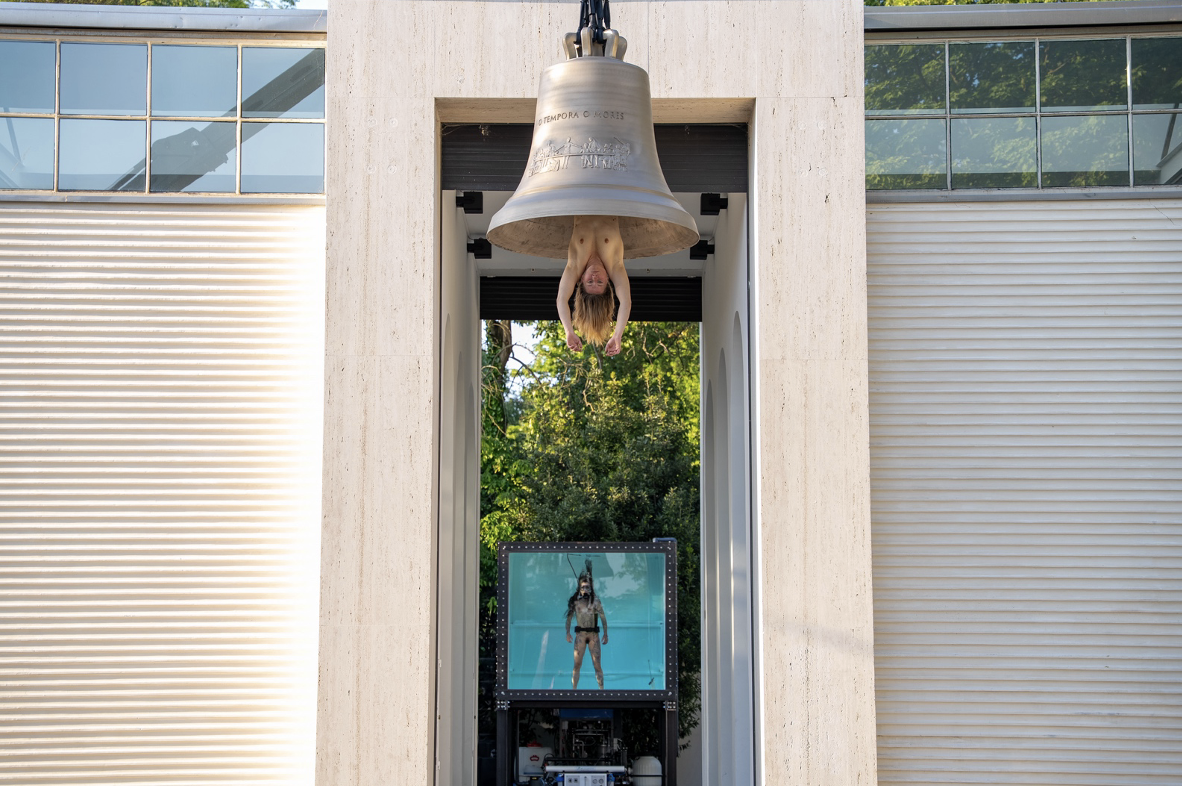
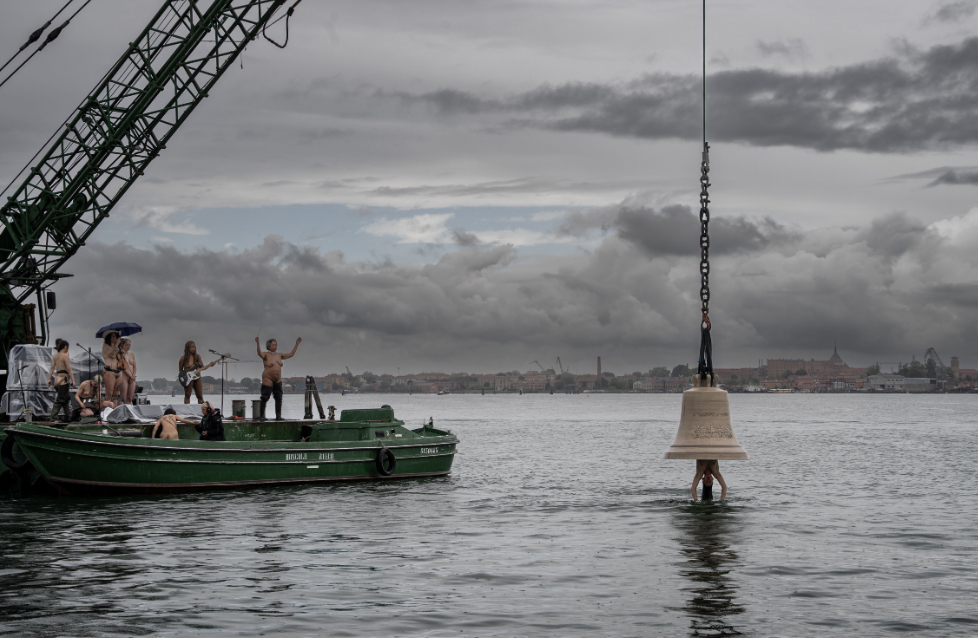
The Opening Étude serves as an inaugural ritual. Recovered from the lagoon and brought to the Pavilion in a procession, a bell opens the Austrian Pavilion and towers over its entrance: a signifier of the sacred, a marker of the passing of time, a call to gather, a warning. The rhythmic, embodied persistence of a female* performer replacing the clapper, rings out the exhausted structures of patriarchal history and religious authority every hour.
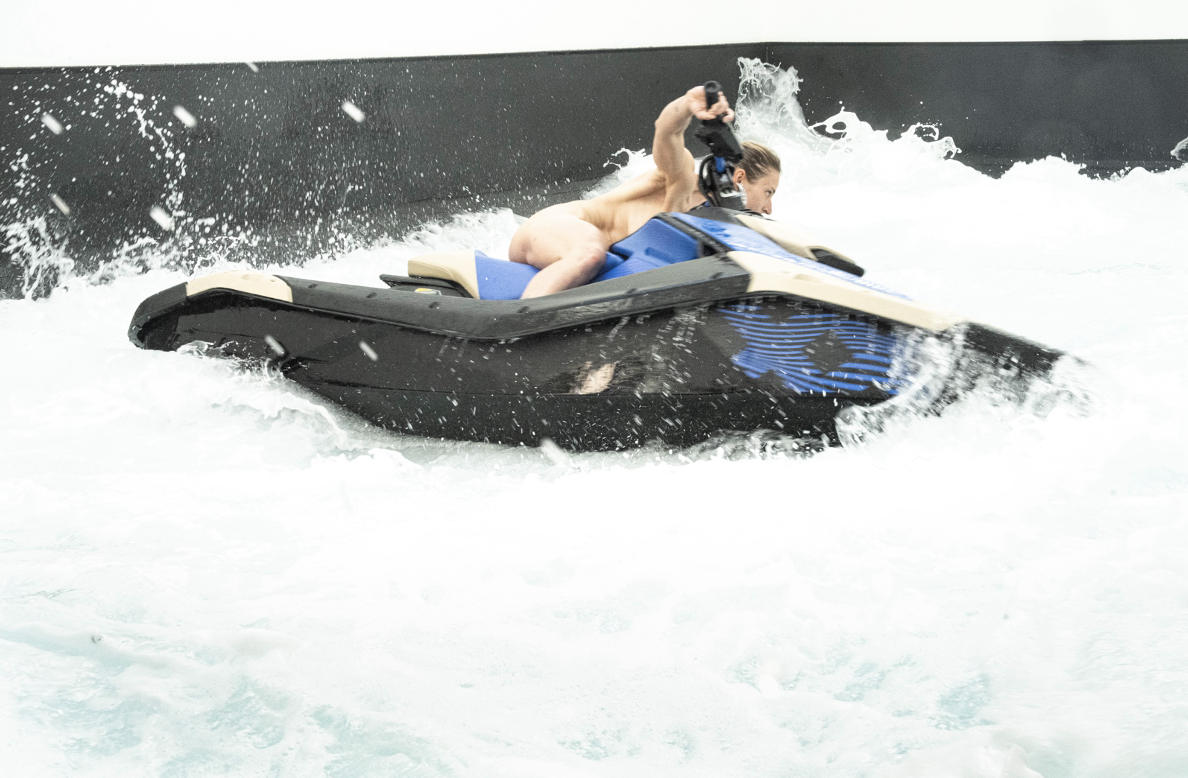
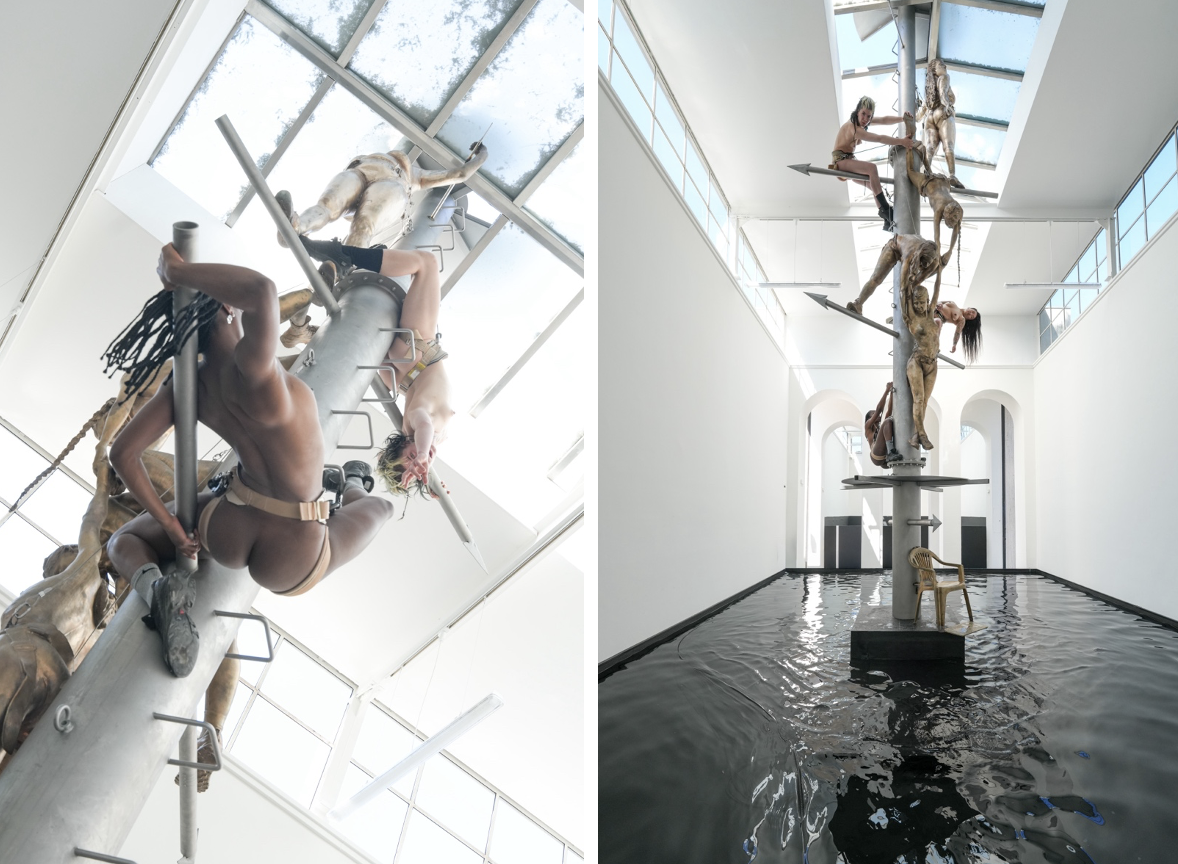
In the flooded pavilion, a jet ski makes its rounds as a monument to the ecological catastrophe driven by turbo-tourism, which continues to collide with a sinking city. At times, the jet ski’s stillness transforms into swirls and waves – an absurd image of confined nature and of mankind’s desire to control it, a play on Holzinger’s ongoing investigation of the body-machine relationality. Opposite, a monumental weather vane pierces the architecture. Historically used to predict the weather and often adorned with mythological figures in ancient times, weather vanes were installed on churches from the ninth century onward before being replaced by modern meteorological technologies. Here, it substitutes the fixed monuments of the past with a rotating, female-led “Deposition of Christ”. This symbol of a holy descent transforms into a revolving monument of collective strength. As the figures spin in the shifting winds, the work proposes a radical departure from the status quo, foreshadowing a defiant direction for a society in flux.
At the back of the pavilion, the promise of progress continues to unfold as a “Frankensteinesque” dystopia: robot dogs move through rising water behind glass, acting as mechanical watchdogs for a central sacrificial altar: a large aquarium flanked by toilets. In the courtyard, a performer lives inside a water tank sustained by visitors’ urine, inhabiting the Austrian Pavilion continuously throughout the Biennale. This closed-loop recycling system serves as a visceral reflection of a global order in which vulnerable populations and entire nations are relegated to the waste of the powerful. Living in this reservoir, the performer strips away the inherited romanticism of Giorgione’s Sleeping Venus (1510) – art history’s first known reclining nude, painted in Venice. She is no longer a silent muse resting on velvet, but a survivor staring out from the wreckage of a civilisation dissolved in urine. In a city where mass tourism collides with ecological fragility, the idea of “beauty” in Venice cannot be separated from the waste it produces.
As curator Nora-Swantje Almes explains: “At the Austrian Pavilion, Florentina Holzinger depicts humankind’s complicity in collapsing systems, questioning established structures and the apparent order of things—and revealing that order itself is inherently unstable. SEAWORLD VENICE pushes the limits of exhibition-making, redefining the pavilion as a temporal, porous system in constant transformation. The water’s surface becomes a reflective mirror, turning SEAWORLD VENICE into an encounter with the self.”
Rising from the depths of the Venetian lagoon and ascending into the city’s skies, Holzinger’s performers – human and otherwise – reveal the vulnerability and resilience of bodies and the world alike. The artist states, “In Venice – a city caught in a profound and precarious relationship with water – my ongoing fascination with this element will take on new dimensions. Here, the body will play a central role in exploring the interdependence and interplay between nature and technology.”
In response to the Biennale’s theme, In Minor Keys, SEAWORLD VENICE employs the abject to subvert polished spectacles of power and progress. By orchestrating a forceful collision between flesh and machinery, Holzinger ruptures “perfect” aesthetic surfaces to confront the raw, visceral realities of social and ecological breakdown—truths often sanitized by institutional narratives. Within these “minor keys,” the pavilion becomes a site of radical feminist resistance, where the body is reclaimed to dismantle hierarchies and assert agency in a collapsing world.
Alongside its presentation at the Giardini della Biennale, SEAWORLD VENICE features a series of performances titled Études, through which the project becomes an open-ended exploration that evolves across multiple formats and locations. The Venice Études are co-commissioned by the Bukhman Foundation, Hartwig Art Foundation and Thaddaeus Ropac Gallery. The Études series will continue as satellite projects building narratives across different geographies, and will be presented at the Vienna Festival, the Nitsch Foundation, Kunsthaus Bregenz, TRANSART – Festival for Contemporary Cultures in Bolzano, and Hartwig Art Foundation in Amsterdam.
SEAWORLD VENICE will be presented in adapted versions at Gropius Bau, Berlin (March 2027) and Kunsthalle Wien, Vienna (June 2027) and Amant, Brooklyn, New York (spring 2028).
NOTES TO EDITORS
Visitor Information
SEAWORLD VENICE
Austrian Pavilion
61st International Art Exhibition – La Biennale di Venezia
www.seaworldvenice.at
Address
Giardini della Biennale
Sestiere Castello, 30122 Venice, Italy
www.labiennale.org
Preview Days + Opening
Preview days: May 6 – 8 2026
Biennale Arte 2026 opening hours: 10 AM – 7 PM
Austrian Pavilion opening hours:
May 5 2026: 11 – 7 PM
May 6 2026: 12.30 – 7 PM
May 7 2026: 11 – 7 PM
May 8 2026: 11 – 7 PM
Opening of the Austrian Pavilion: May 6 2026 | 12.30 PM
Opening Étude: May 6 2026
Exhibition duration: May 9 – November 22 2026
General Opening Hours
Summer hours (May 9–September 30, 2026)
Giardini: 11 AM – 7 PM
Arsenale: Tuesday–Thursday and Sundays | 11 AM – 7 PM
Fridays and Saturdays | 11 AM – 8 PM
Fall hours (October 1–November 22, 2026)
Giardini and Arsenale: 10 AM – 6 PM
Closed Mondays (except May 11, June 1, September 7, and November 16)
SEAWORLD VENICE is realised on behalf of the Austrian Federal Ministry of Housing, Arts, Culture, Media and Sport, Division IV – Arts and Culture. The lead partners and Étude commissioners are the Bukhman Foundation, Hartwig Art Foundation and Thaddaeus Ropac Gallery. The project is supported by the following partners: the Friends of the Austrian Pavilion, Eva Dichand, Phileas – The Austrian Office for Contemporary Art, and More Spirit Please. The institutional partners are Ursula Blickle Stiftung, Gropius Bau / Berliner Festspiele (Berlin), Amant (Brooklyn, New York), and Kunsthalle Wien (Vienna). Public funding is contributed by Land Niederösterreich, Land Salzburg, Land Kärnten, and the City of Vienna. The full list of project partners can be found here: https://www.seaworldvenice.at/thank-you
About Florentina Holzinger
Holzinger’s works have been awarded the Nestroy (TANZ, 2020) and DER FAUST awards (Ophelia’s Got Talent, 2023) and have been selected by the Theatertreffen Berlin four times in a row (TANZ, Ophelia’s Got Talent, SANCTA, A Year without Summer). In addition to her stage productions, Holzinger creates Études, an ongoing series of site-specific, one-off performances in public space that have been presented in collaboration with the Schinkel Pavillon, Berlin; Bergen Kunsthall; Berlin Atonal Festival; and the Vienna Festival, among others. Since 2021, she has been an associate artist at Volksbühne am Rosa-Luxemburg-Platz, Berlin. Since February 2026 she has been represented by Thaddaeus Ropac Gallery.
About Nora-Swantje Almes
Nora-Swantje Almes is a curator with a focus on performance in the visual arts context and on performative exhibition formats. She has been curator of the Live Programme and Outreach at Gropius Bau, Berlin, since 2024. Prior to this, she headed the Live Programme at Bergen Kunsthall, Norway, for three years, where she developed the commissioned work Harbour Étude with Florentina Holzinger and her team in summer 2024. In her curatorial career, she has held positions at Glasgow International, Participant Inc., New York; Artangel, London; and the Schinkel Pavillon, Berlin.
Image Credits:
1-4. SEAWORLD VENICE by Florentina Holzinger for the Austrian Pavilion, Biennale Arte 2026. Photography by Nicole Marianna Wytyczak