Press Preview: October 8 | 10 AM – 1 PM
Press Conference: October 8 | 11 AM
Opening: October 8, 2026 | 7 PM
On View: October 9, 2026 – January 17, 2027
September 14, 2026 (Berlin, Germany) – Through striking political actions and projects spanning theatre, opera, film and the visual arts, Christoph Schlingensief (1960–2010) turned an unflinching gaze upon the absurdities of the present. From October 9, 2026 – January 17, 2027, Gropius Bau will present Es ist nicht mehr mein Problem, macht eure Scheiße alleine (It’s not my problem anymore, deal with your own shit), an exhibition illuminating his visionary, genre-defying body of work. The artist’s most comprehensive German showcase in over a decade, it is conceived not as a traditional retrospective, but as a dynamic dialogue between key groups of Schlingensief’s works.
Christoph Schlingensief was one of the most influential German artists of his generation. Although his works responded directly to the political and social issues of their time, they remain highly relevant today: his early engagement with colonialism, discrimination and the fragility of democratic societies resonates with key contemporary debates, as does his call for political engagement and debate. Spanning eight rooms and the central atrium, the exhibition Christoph Schlingensief: Es ist nicht mehr mein Problem, macht eure Scheiße alleine features installations and video works contextualised by documentary film and archival material. Nine groups of work from the late 1990s to the late 2000s lay bare his artistic strategies and the constant process of questioning, doubting and failing that characterised his practice.
One can fail with enthusiasm, joy and intent. […] Much will happen if one manages to accept that failure is necessary for harnessing strength.
–Christoph Schlingensief
Schlingensief’s artistic strategies included deliberately overwhelming and unsettling the audience. Alongside humorous exaggerations and parodies, he consciously drew on discriminatory images and language to make them visible, thereby constantly testing the limits of what could be said and done. His criticism was not directed solely outwards; he never stopped questioning his own role as a widely debated artist.
The exhibition begins in the Gropius Bau atrium – which is open to the public free of charge – with the large-scale installation Kaprow City (2006/07), a work closely associated with Schlingensief’s time in Berlin. The rotating stage, originally designed for an audience to walk in, was created in 2006 for his last theatre production at the Volksbühne in Berlin, a piece that speculates on the final hours of Lady Diana’s life prior to her fatal accident in 1997. In 2007, he transformed the stage set into a stand-alone work of art for the Migros Museum für Gegenwartskunst in Zurich. In the installation, footage from the stage production, fragments from earlier projects and Super 8 films from Schlingensief’s childhood overlap within individual cinema chambers to create a visual space that can never be comprehended in its entirety. Among the few installation works by the artist that remain, Kaprow City exemplifies his cross-genre, media-reflexive and deliberately overwhelming approach.
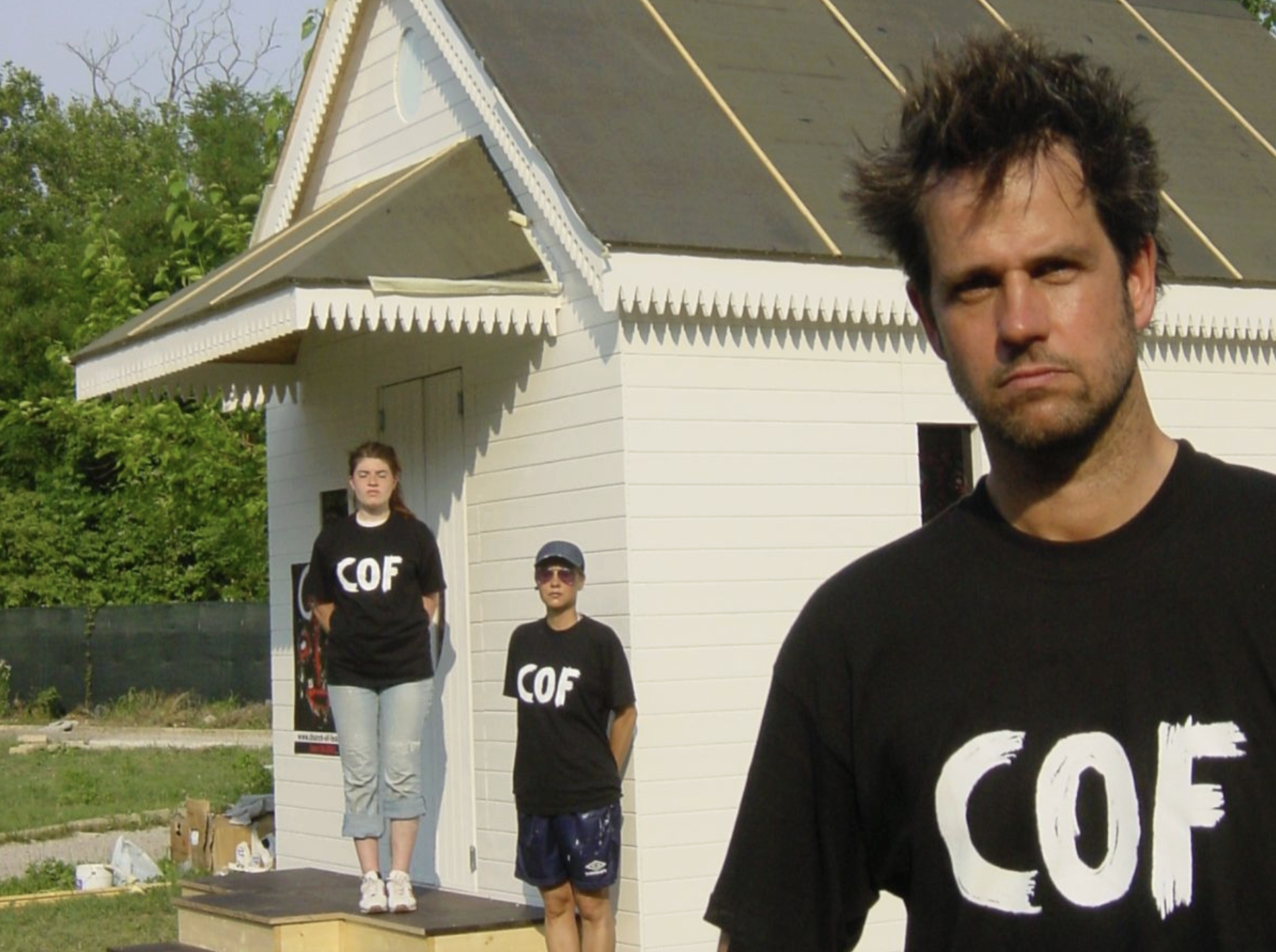
The first exhibition room features another installation: Church of Fear, first presented at the 2003 Venice Biennale. Created against the backdrop of the political and media reactions to the 9/11 attacks, the work explores the instrumentalisation of fear, the political construction of alleged threats and the expansion of state control. Founded on the day American troops invaded Iraq, the Church of Fear was conceived as a parodic religious community whose sole dogma was “belief in fear.” Through sermons, ritualistic actions and interventions in public space, Schlingensief challenged his audience to confront their individual and collective fears and reckon with the fact of their social and political co-optation. In doing so, he brought together diverse religious and cultural elements and traditions within an ambivalent space between art, religion and public discourse. Proceeding from Church of Fear, the exhibition unfolds along two temporal pathways.
Late 1990s and early 2000s: between performance, political activism and the public sphere
The backward-looking pathway brings together political and performance-based works from the late 1990s and early 2000s in which Schlingensief interwove art, activism, the media and the public. During this period, theatre, television and public space became settings for artistic interventions through which he exposed social conflicts and challenged existing power structures.
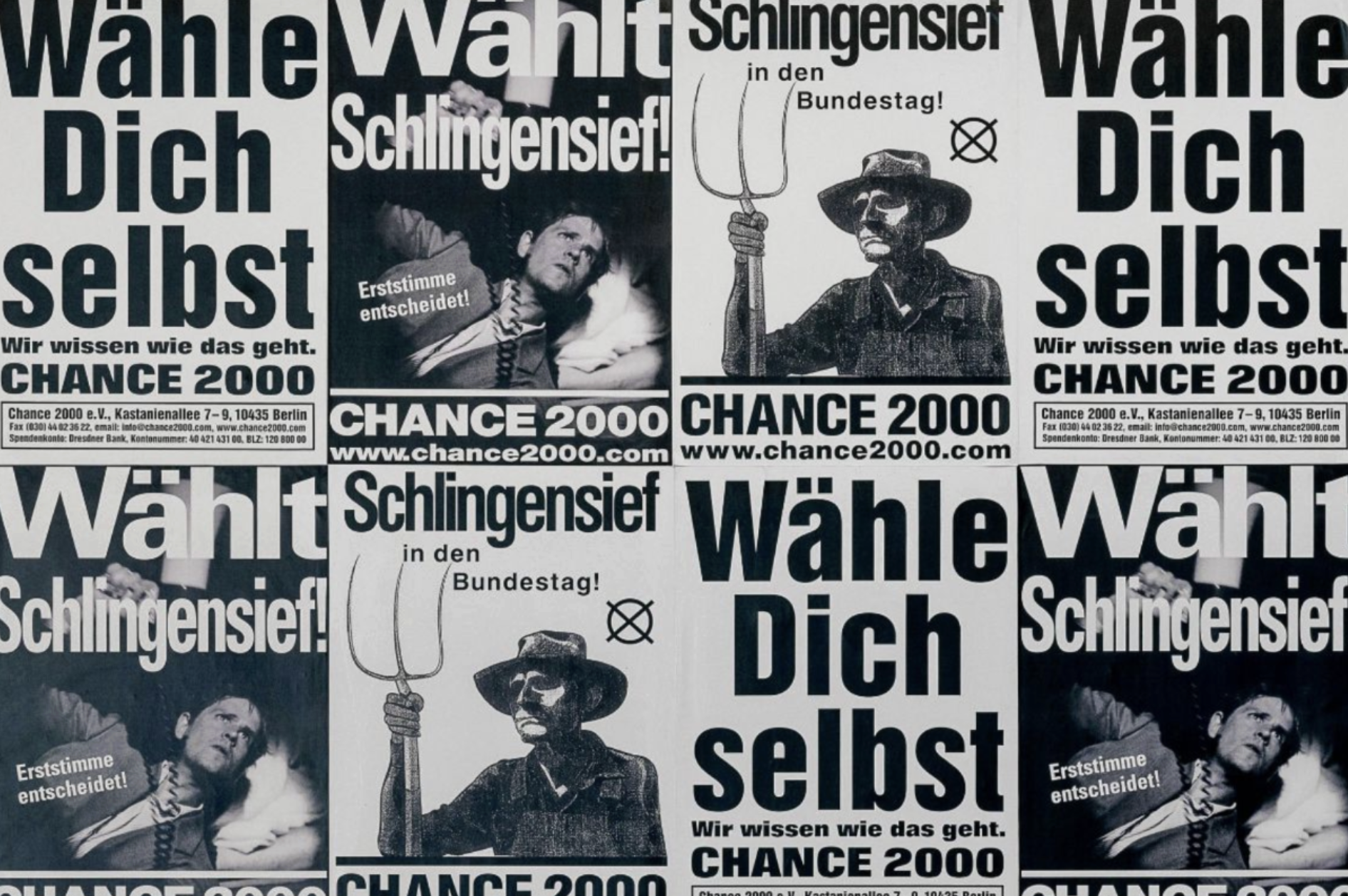
With Chance 2000 (1998–1999), he founded his own political party in the run-up to Germany’s Bundestag election, elevating failure into a political and artistic principle. The party was conceived as a platform for those who were marginalised within a meritocratic society and barely represented in its political system, including people with disabilities and those who were unemployed or homeless. Its slogan, “Vote for yourself!”, urged them to take political representation into their own hands.
Hamlet – This Is Your Family (2001) drew parallels between Shakespeare’s tragedy and the debate surrounding society’s approach to right-wing extremists at the turn of the millennium. The production at the Schauspielhaus Zurich included neo-Nazis who claimed to want to leave the scene, confronting both the audience and participants with the question of whether a credible break with right-wing ideology is even possible.
For Freakstars 3000 (2002), Schlingensief continued his close, long-standing collaboration with performers with disabilities. Working with residents of the Tiele-Winckler-Haus, a residential and care facility in Berlin, he created a six-part television series broadcast on Viva Plus, a German music channel. The project appropriated the aesthetics of talent competitions and political talk shows while incorporating parodic references to historical “freak shows” as a way of exploring questions about self-determined representation, the participation of people with disabilities and societal norms.
Mid-2000s: between film, opera and overwhelm as an artistic strategy
The forward-looking pathway focuses on bodies of work in film and opera in which Schlingensief combined historical, social, mythological and media-related motifs to create multi-layered realms of imagery and meaning. Genres interpenetrate one another, visual worlds collide and narratives disintegrate only to reassemble themselves into new provisional relationships. Overwhelming the viewer is not a side effect but a central aesthetic principle of Schlingensief’s practice.
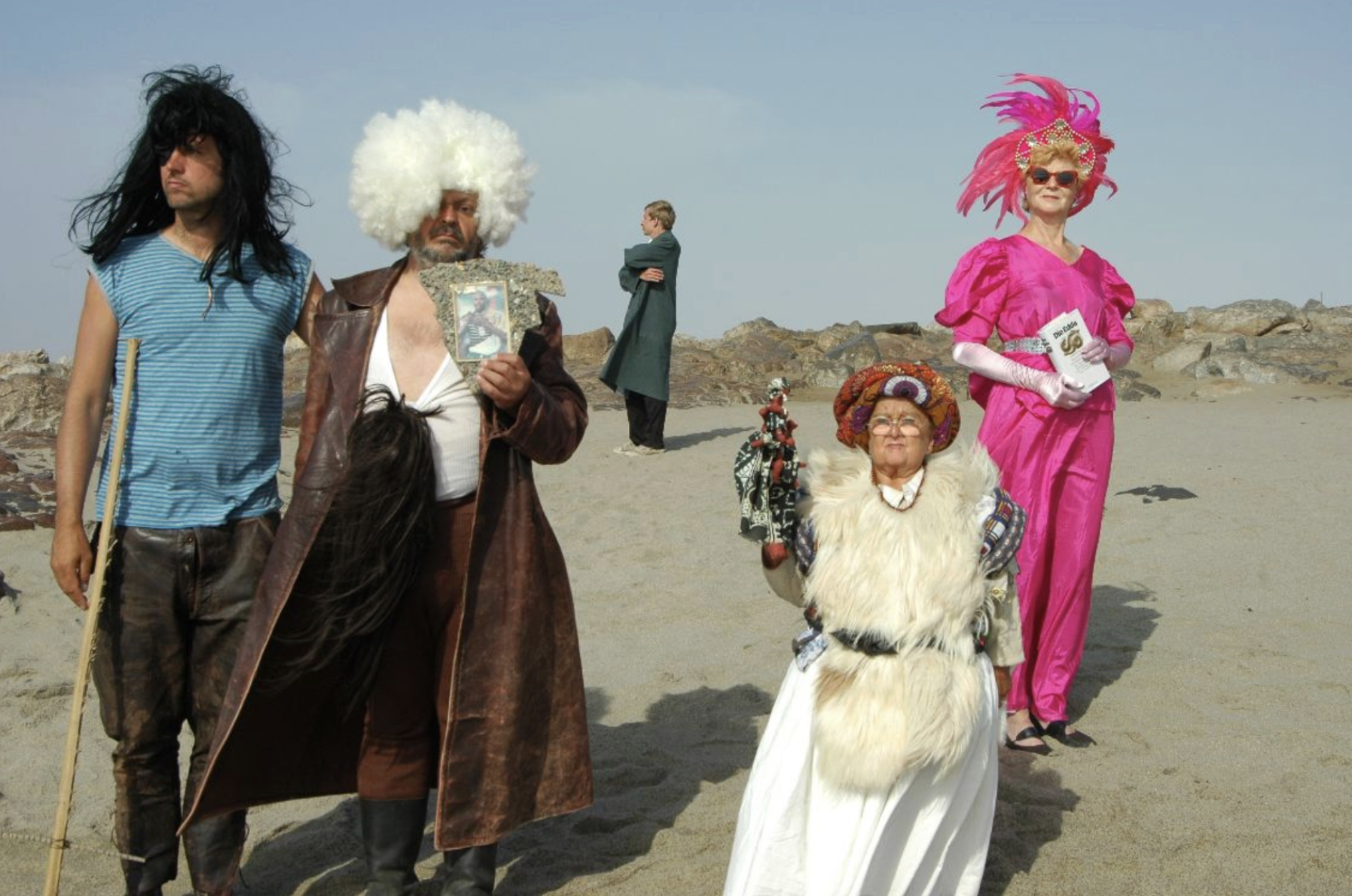
The African Twin Towers (2005/07) was initially conceived as a fictional narrative about a music festival organised in Namibia by the descendants of Richard Wagner. During filming in the Namibian town of Lüderitz, this premise evolved into a deeply collaborative, improvisational process between the actors and local residents. Together, they re-enacted Norse heroic sagas from Wagner’s operas, Western film classics and scenes from the colonial era. The resulting 18-channel video installation, composed of unedited raw footage, creates a polyphonic, fragmented visual space that reflects on the (im)possibility of visualising and representing colonial violence.
The video work Ohne Titel (“Der Fliegende Holländer,” Manaus) (Untitled (“The Flying Dutchman,” Manaus)) (2007) emerged out of Schlingensief’s production of Richard Wagner’s opera of the same name at the Teatro Amazonas in Manaus, Brazil – a staging that bound questions of life, death and redemption to complex ecological and postcolonial realities. In Manaus, too, he collaborated with local people, incorporating local dances and music to dismantle the Eurocentric and elitist nature of traditional opera. At the same time, he stridently drew upon colonial motifs to offer a self-ironic commentary on his own ambivalent role as a European artist in the Amazon region.
Finally, Ohne Titel (Hasenverwesung; Drosophila Melanogaster; Holländer 2c. Ausweitung der Dunkelphase; Fremdverstümmelung) (Untitled (Hare Decay; Drosophila Melanogaster; Holländer 2c. Expanding Dark Phase; External Mutilation)) (2007) weaves four different films from Schlingensief’s opera projects into an immersive video installation. This cross-work composition brings together central themes of his later output: reflection on the mechanisms of exclusion within high culture, working with people who fall outside conventional body ideals and the question of how art can open spaces that simultaneously unsettle and connect.
Christoph Schlingensief consistently dissolved the boundaries between theatre, film, opera, political action and visual art. His works confront us with the contradictions of their time and challenge us to continually re-examine social realities. The show operates in direct dialogue with two concurrent projects at Gropius Bau: a solo exhibition by Gabriele Stötzer and the group show Kreuzberg: Kunst und Migration seit 1960 (Kreuzberg: Art and Migration since 1960). Together, they offer a polyphonic perspective on Germany’s recent history, paving the way for the major spring 2027 group exhibition at Gropius Bau, which will explore Germany as a thematic focus.
–Jenny Schlenzka, Director, Gropius Bau
With this exhibition, Gropius Bau deepens its exploration of artistic approaches that operate across genres and deliberately transcend their boundaries. In Schlingensief’s practice, art becomes a living, open-ended process that continually re-negotiates its relationship to the present and challenges the audience to take an active stance. His explorations of German history, right-wing extremism and the political culture of his time add another perspective to the Gropius Bau’s programmatic focus on Germany’s recent history. Viewed together, Christoph Schlingensief’s show, Gabriele Stötzer’s solo exhibition and the group show Kreuzberg bring diverse experiences in East and West Germany, historical continuities and forms of exclusion and resistance into dialogue with one another, underscoring how closely these themes are linked to current societal debates.
---
NOTES TO EDITORS
To attend the press preview and for interview requests, please contact gropiusbau@annarosathomae.com.
The live programme includes performances, a concert and screenings. On 19 November, a new edition of the free event series Spätschicht, curated in collaboration with director and artist Anta Recke, will explore contemporary perspectives on Christoph Schlingensief's work. On November 20 and 21, the Volksbühne am Rosa-Luxemburg-Platz will present a special programme on Christoph Schlingensief to coincide with the exhibition, together with Gropius Bau / Berliner Festspiele.
The exhibition is curated by Raphael Gygax, Curator, together with Dalwin Kryeziu, Fellow to the Director, Gropius Bau, and Christopher Wierling, former Assistant Curator, Gropius Bau, in collaboration with Aino Laberenz, Christoph Schlingensief Estate.
Exhibition Management: Simone Schmaus, Head of Exhibitions and Production, and Filippa Carlini, Project Management, together with Lisa Bockius, Exhibitions Fellow
A joint project by Gropius Bau / Berliner Festspiele, Wiener Festwochen | Freie Republik Wien, and MAK - Museum of Applied Arts
Address
Gropius Bau
Niederkirchnerstraße 7
10963 Berlin
Opening Hours
Monday, Wednesday – Friday | 12 – 7 PM
Saturday, Sunday, Holidays | 10 AM – 7 PM
Closed on Tuesdays
About Christoph Schlingensief:
From his very first films, the artistic work of Christoph Schlingensief (1960–2010) consistently sparked aesthetic and political controversy. His signature techniques of superimposition and overload were evident from the start – a way of working at the boundaries of the perceptible, where new narrative spaces emerge.
Even as a child and teenager, Schlingensief was passionate about filmmaking. In the 1980s, he worked as an assistant to the German experimental filmmaker Werner Nekes. After making numerous short films, he shot his first feature in 1984: Tunguska – Die Kisten sind da (Tunguska: The Crates Are Here). This was followed by works such as Menu total (Meat, Your Parents) (1985), Egomania – Insel ohne Hoffnung (Egomania: Island Without Hope) (1986) and Mutters Maske (Mother’s Mask) (1987/88). Between 1989 and 1992, he made the Germany Trilogy (100 Jahre Adolf Hitler – Die letzte Stunde im Führerbunker (100 Years of Adolf Hitler: The Last Hour in the Führerbunker), Das deutsche Kettensägenmassaker (The German Chainsaw Massacre) and Terror 2000 – Intensivstation Deutschland (Terror 2000: Germany Out of Control)).
In 1993, he staged his first theatre production, 100 Jahre CDU – Spiel ohne Grenzen (100 Years of the CDU: Game Without Borders), at the Volksbühne in Berlin. The theatre became the central venue for his stage work, with numerous projects including Rocky Dutschke ‘68 (1996), Berliner Republik oder der Ring in Afrika (The Berlin Republic – or the Ring in Africa) (1999) and ATTA ATTA – Die Kunst ist ausgebrochen (ATTA ATTA – Art has broken loose) (2003). Schlingensief also worked at other major theatres and opera houses, including the Bayreuther Festspiele, the Burgtheater in Vienna and the Schauspielhaus Zurich, developing an extensive and distinctive body of work across theatre and opera. His plays and projects were included a total of three times in the Berliner Festspiele’s Theatertreffen selection, an annual shortlist honouring the ten most remarkable productions of the year from Germany, Austria and Switzerland. He was chosen in 2005 for Kunst und Gemüse, A. Hipler (Art and Vegetables, A. Hipler), in 2009 for Eine Kirche der Angst vor dem Fremden in mir (A Church of Fear of the Stranger in Me) and in 2011 for Via Intolleranza II.
In the late 1990s and 2000s, he captured wider public attention through politically charged interventions while increasingly appearing in international exhibitions. In 1997, for example, he staged the 48-hour performance Mein Filz, mein Fett, mein Hase – Überleben für Deutschland (My Felt, My Fat, My Hare – 48 Hours Survival for Germany) at documenta X. And in 1999, at the invitation of MoMA PS1 in New York, he staged the action Deutschland versenken (Sink Germany), followed in 2003 by the Church of Fear installation and performance at the 50th Venice Biennale. With expansive installations such as 18 Bilder pro Sekunde (18 Frames Per Second) at Munich’s Haus der Kunst in 2007, Schlingensief renewed his intense engagement with the medium of film. Later that year, several bodies of his film-based work were brought together in the largest solo exhibition of his lifetime: Querverstümmelung (Cross Mutilation) at the Migros Museum für Gegenwartskunst (2007–08). In 2008, he was diagnosed with lung cancer, an experience that shaped his later work. Following his death, he was posthumously awarded the Golden Lion for the German Pavilion at the Venice Biennale in 2011.
Image credits:
1. Christoph Schlingensief, Church of Fear, Biennale Venedig, 2003, courtesy: Estate of the artist © Christoph Schlingensief, photo: Edzard Piltz
2. Christoph Schlingensief, Chance 2000 – Partei der letzten Chance, 1998, installation view, CHRISTOPH SCHLINGENSIEF. Es ist nicht mehr mein Problem!, MAK, 2026 © Aino Laberenz, photo: kunst-dokumentation.com/MAK
3. Christoph Schlingensief, The African Twin Towers, 2005 © Aino Laberenz